

Private Label Chocolate Manufacturing: How to Reduce Commercial Risk
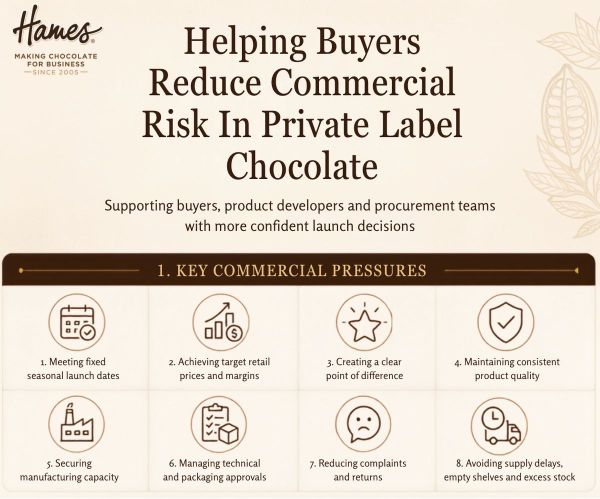
Launching a new private label chocolate product is exciting, but for buyers, product developers and procurement teams it also carries a considerable amount of commercial responsibility. A product may look fantastic on paper, but it still needs to achieve the right price point, appeal to the target customer, be manufactured consistently and arrive on shelf at exactly the right time.
With more than 20 years of chocolate manufacturing experience, we understand that successful private label development is about much more than creating a great tasting product. Over the years, we have seen how decisions made at the earliest stages of a project can have a significant impact on cost, manufacturing efficiency, lead times and ultimately the commercial success of a launch.
Planning Around Fixed Launch Dates
For seasonal confectionery in particular, there is often very little room for error. Easter, Christmas, Valentine’s Day and Halloween all have fixed selling windows. If production or packaging is delayed, even by a relatively short period, the commercial impact can be significant. Unlike an everyday product, a missed seasonal launch date cannot simply be pushed back by a few weeks.
Manufacturing capacity also needs to be considered earlier than many people realise. Seasonal chocolate production is planned months in advance and popular production periods can become heavily committed. Drawing on years of experience in seasonal manufacturing, we can help customers understand realistic lead times, production requirements and potential pressure points before they become problems.
Balancing Cost, Margin and Product Appeal
Price and margin are equally important. Buyers are often working backwards from an established retail price, which means product design, chocolate specification, format, decoration and packaging all need to be considered within a defined cost framework. A concept may be technically possible to manufacture, but that does not necessarily mean it will deliver the required commercial return.
This is where manufacturing experience becomes particularly valuable. Having developed and produced chocolate products across a wide range of formats, volumes and seasonal programmes, we know the questions that need to be asked early. Sometimes a relatively small change to a product format, specification or packaging choice can improve manufacturing efficiency, protect margin or reduce unnecessary complexity without compromising the overall consumer proposition.
Creating Difference Without Adding Unnecessary Complexity
Creating a clear point of difference is an important part of private label development. Retailers and brands naturally want products that stand out, particularly within highly competitive seasonal ranges.
However, greater complexity can sometimes introduce additional manufacturing cost, longer production times or more complicated packaging requirements. The objective is therefore not simply to create the most elaborate product possible, but to find the right balance between impact, practicality and commercial viability.
Managing Technical And Packaging Requirements Early
Technical and packaging approvals can also influence timescales. Artwork, print lead times, specifications, nutritional information, product testing and packaging compatibility can all form part of the development process.
Managing these stages alongside product development, rather than treating them as separate activities, can help avoid unexpected delays later and give buyers greater visibility of the route to launch
Designing For Consistency At Scale
A successful launch is not simply about producing an impressive initial sample. The finished product needs to deliver the same experience across thousands, and sometimes hundreds of thousands, of units.
Chocolate appearance, weight, flavour, decoration and packaging all contribute to the consumer experience and can ultimately influence complaints, returns and repeat purchasing.
This is another area where established manufacturing knowledge matters. Experience helps identify what will work reliably in full scale production, not just in development. Designing with repeatability in mind from the beginning can help maintain consistent quality while reducing the likelihood of avoidable production issues.
Managing Volume And Seasonal Stock Risk
Volume forecasting introduces another commercial consideration, particularly for seasonal ranges. Producing too little can result in missed sales and empty shelves, while producing too much can leave retailers carrying unwanted stock once the seasonal window closes.
Understanding realistic manufacturing quantities, production efficiencies and order requirements early can help buyers make more informed decisions about volumes and ranging.
Asking The Right Questions Before Launch
Ultimately, reducing commercial risk in private label chocolate comes down to asking the right questions early enough. Is the concept achievable at the required retail price? Can it be produced consistently at the anticipated volume? Is the packaging practical? Is sufficient manufacturing capacity available? Can every stage be completed in time for the required launch date?
Our role as an experienced private label chocolate manufacturer is to help customers answer those questions before major commitments are made. By bringing together more than two decades of manufacturing knowledge with an understanding of product development, cost, packaging and production requirements, we can help identify potential challenges early and support better-informed commercial decisions.
That experience cannot remove every element of risk from a new product launch, but it can make the journey from initial concept to finished product considerably more predictable, giving buyers greater confidence that when launch day arrives, the product will be ready for the shelf.